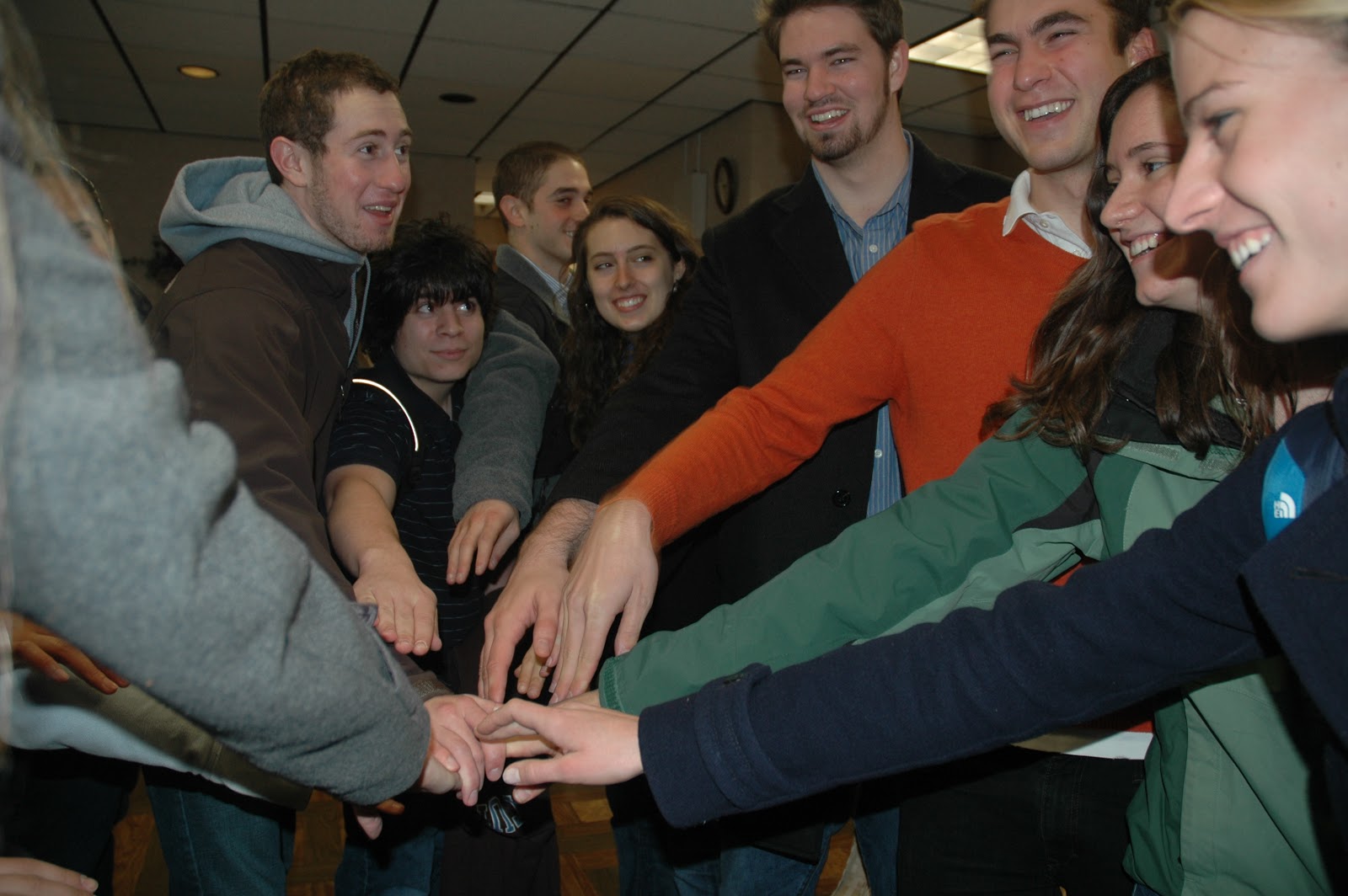
This semester several students from Tufts are volunteering with a program called Gateways as the start of a new partnership with Hillel. Gateways is an organization based in Boston that provides access to Jewish education for children and young adults with special needs. With this organization, we are hosting several students with special needs to our Shabbat services at Hillel. The participants, mostly from the Boston area, are around college-aged and they are extremely enthusiastic to be part of this program.
I got involved with Gateways because I thought it would make my Shabbat experience very special. I think everyone deserves a chance to celebrate Shabbat with their community. I wanted to grant this opportunity to members of my faith who may not always have access to a Shabbat service. I also hope to form friendships with the young adults with special needs. Although I don’t have much experience working with people with special needs, I thought it would be rewarding to interact with them, especially on Shabbat.
Before the first Shabbat service with Gateways, the Tufts students involved in the program attended a training session. During this session we discussed how to interact with the participants and how to make them feel comfortable in a new environment. We also went over the schedule for the program and simulated situations that might occur during the service. The training was a great experience that made me feel prepared and excited for my interactions with the participants.
The first Shabbat was a success. My friend and I were paired with our “buddy,” a girl from Boston who was excited to be at Hillel. Before services began, we discussed the meaning of Shabbat. Both the volunteers from Tufts and the participants from Gateways agreed Shabbat stands out form the rest of the week because it is a time for relaxation and reflection. It was easy to connect with the participants, as they were thrilled to be at services and amongst such warm and supportive college students. I particularly enjoyed eating dinner with my “buddy,” who joked around with me because I am not familiar with the geography of my hometown, Boston. Overall, the Gateways program made my Shabbat a very special experience. I look forward to the next one!
Monday, February 28, 2011
Monday, February 21, 2011
Storytelling: Rebecca Matyas ‘13
Once upon a time, there was a quiet village. Then, one terrible day, a fearsome dragon began to terrorize the villagers. Luckily, a brave hero stepped in to slay the dragon and return peace to the countryside…
Last week, I attended community organizing training focusing on storytelling by the Jewish Organizing Initiative (JOI). Two professionals from JOI spent the afternoon us, a group of Jewish student leaders, both board members and others, who wanted to learn tools to make a difference in the world. We learned about structuring our personal stories in the most effective way to express ourselves, with a clear beginning, middle, and end like the story of dragon and the village. Then, we discussed ways that storytelling can be useful in inspiring people to action, making connections with others, and helping others find connections with each other. Finally, we practiced our own stories and gave each other constructive criticism.
Storytelling is a tool that I use a lot as a CEI intern, especially in one on one coffee dates. For instance, many of my engagees are uncomfortable in Jewish settings where they feel they are “not Jewish enough.” I believe that no one should feel inadequate or excluded because of their beliefs or choices, so I will often tell a story about a time that I had doubts about aspects of Judaism, where a certain belief or custom did not seem like something I wanted to incorporate into my own practices. Hearing how I reconciled my personal Judaism within a broader Jewish context has been comforting or validating for several of my engagees because it allows them to see how their doubts or choices contribute richness to their own Judaism without detracting from “how Jewish they are.” With this validation, people can feel more comfortable exploring their options without being deterred contexts outside their comfort zones.
I use my stories to connect with people of all different backgrounds and encourage them to tell me their stories so that I can learn what they are passionate about and help them find opportunities to take ownership of their Judaism in ways that are important to them. While storytelling was a tool I was using regularly, I really enjoyed the workshop because it helped me reexamine the tools that I use every day and will allow me to be more intentional and successful in my own storytelling.
Last week, I attended community organizing training focusing on storytelling by the Jewish Organizing Initiative (JOI). Two professionals from JOI spent the afternoon us, a group of Jewish student leaders, both board members and others, who wanted to learn tools to make a difference in the world. We learned about structuring our personal stories in the most effective way to express ourselves, with a clear beginning, middle, and end like the story of dragon and the village. Then, we discussed ways that storytelling can be useful in inspiring people to action, making connections with others, and helping others find connections with each other. Finally, we practiced our own stories and gave each other constructive criticism.
Storytelling is a tool that I use a lot as a CEI intern, especially in one on one coffee dates. For instance, many of my engagees are uncomfortable in Jewish settings where they feel they are “not Jewish enough.” I believe that no one should feel inadequate or excluded because of their beliefs or choices, so I will often tell a story about a time that I had doubts about aspects of Judaism, where a certain belief or custom did not seem like something I wanted to incorporate into my own practices. Hearing how I reconciled my personal Judaism within a broader Jewish context has been comforting or validating for several of my engagees because it allows them to see how their doubts or choices contribute richness to their own Judaism without detracting from “how Jewish they are.” With this validation, people can feel more comfortable exploring their options without being deterred contexts outside their comfort zones.
I use my stories to connect with people of all different backgrounds and encourage them to tell me their stories so that I can learn what they are passionate about and help them find opportunities to take ownership of their Judaism in ways that are important to them. While storytelling was a tool I was using regularly, I really enjoyed the workshop because it helped me reexamine the tools that I use every day and will allow me to be more intentional and successful in my own storytelling.
Monday, February 7, 2011
Lisa Ling Raising a Moral Voice: Nat Schils '12
This past Tuesday Lisa Ling, an internationally renowned journalist, came to Tufts for the Merrin Distinguished Lecture which is presented annually by Tufts Hillel. Even though I had heard that Lisa Ling had covered fascinating stories around the world, gaining access to previously closed off locations and speaking about ignored or taboo topics, I was blown away by the breadth of her experience. She spoke about her time in Afghanistan, where she saw boys as young as fourteen wielding guns like trained military men. She met with American couples traveling to China to adopt baby girls. She spent time at a maximum-security penitentiary, traveled in North Korea, and explored the disturbing truths of prostitution in the United States.
Apart from her stories, however, what struck me most during her speech was when she talked about the dangers of “American style glasses” through which we often dilute complex issues into black-and-white, wrong vs. right, simplicity. Lisa Ling recounted numerous experiences when her oversimplification of a complex issue was blown apart when she started investigating a story at the ground level, interacting with community members and those who had first-hand knowledge and experience with the issues. One example she used was of a policy in Australia that allows women with children under the age of five to bring their children with them if they are jailed. While this policy may seem akin to child abuse and endangerment at first, Lisa Ling came to see another side of the story through her investigative work. She shared statistics about the increased risk that children with one or more incarcerated parent will themselves end up in jail, as well as the decreased incidents of violence at jails when children are present. While many in the audience may still not have agreed with this policy, it definitely brought to light the importance of complete knowledge before making hasty, and potentially inaccurate, assumptions about the lives and decisions of other people.
In continuation with this theme of knowledge before judgment, Lisa Ling also stressed the importance and power of listening. While many people are surprised by Lisa Ling’s ability to infiltrate seemingly closed-off areas, she attributes her success to her commitment to listening carefully and to spending time with people in order to gain their confidence and trust. Rather than promoting monetary action and donations to support a cause, Lisa Ling encouraged audience members to bring global stories to light and to spread awareness about different conflicts that exist both in our own backyards and around the world. By spreading awareness, we can decrease our dependence on “American style glasses” as we begin to think differently about complex issues like environmental justice, female empowerment, and the rights of children. Perhaps it is a human instinct to simplify what the world presents us, especially in today’s increasingly technology-dependent world in which we are constantly bombarded by information and images. I hope that we can all remember Lisa Ling’s words and the importance of being open as we continue to explore global and domestic stories in Tufts classrooms and in the wider world.
Apart from her stories, however, what struck me most during her speech was when she talked about the dangers of “American style glasses” through which we often dilute complex issues into black-and-white, wrong vs. right, simplicity. Lisa Ling recounted numerous experiences when her oversimplification of a complex issue was blown apart when she started investigating a story at the ground level, interacting with community members and those who had first-hand knowledge and experience with the issues. One example she used was of a policy in Australia that allows women with children under the age of five to bring their children with them if they are jailed. While this policy may seem akin to child abuse and endangerment at first, Lisa Ling came to see another side of the story through her investigative work. She shared statistics about the increased risk that children with one or more incarcerated parent will themselves end up in jail, as well as the decreased incidents of violence at jails when children are present. While many in the audience may still not have agreed with this policy, it definitely brought to light the importance of complete knowledge before making hasty, and potentially inaccurate, assumptions about the lives and decisions of other people.
In continuation with this theme of knowledge before judgment, Lisa Ling also stressed the importance and power of listening. While many people are surprised by Lisa Ling’s ability to infiltrate seemingly closed-off areas, she attributes her success to her commitment to listening carefully and to spending time with people in order to gain their confidence and trust. Rather than promoting monetary action and donations to support a cause, Lisa Ling encouraged audience members to bring global stories to light and to spread awareness about different conflicts that exist both in our own backyards and around the world. By spreading awareness, we can decrease our dependence on “American style glasses” as we begin to think differently about complex issues like environmental justice, female empowerment, and the rights of children. Perhaps it is a human instinct to simplify what the world presents us, especially in today’s increasingly technology-dependent world in which we are constantly bombarded by information and images. I hope that we can all remember Lisa Ling’s words and the importance of being open as we continue to explore global and domestic stories in Tufts classrooms and in the wider world.
Sunday, December 19, 2010
Connecting with the Boston Jewish Community: Sofi Shield '14
On November 21st, I went with a group of other Moral Voices members to Temple Shalom in Medford to help them make pies. We went in two shifts, both of which were welcomed with open arms (and freshly baked donuts!) by the appreciative temple members. Making pies was a fun activity, but connecting with the Jewish community in Boston was definitely what I think the overall achievement and reward from the outing. The temple members were all interested in who we were and eager to engage us in conversation, and we also enjoyed ourselves playing with the little children who were running around the social hall.
Making a connection with another Jewish community in the area is something that I think is very important for Moral Voices and Tufts Hillel. Whether we pair up for events in the future, or are just there to support each other, I am very happy to have been able to be a part of establishing this relationship. In fact, three freshman(Simmone Seymour, Ariel Bronstein and myself) went back to help out on December 5th for the Temple Shalom Hannukah party. After being offered copious amounts for delicious latkes and sufganiyot, we headed to our stations. The three of us helped in running the children’s games. “Bowl to Knock over the Greeks,” “Dreidel Darts,” and “Pin the Candle on the Menorah” were all featured activities and the kids would play turn after turn, eager to beat their score from the previous round. At one point,a blind lady asked to bowl and Ariel guided her through the game time after time as the lady smiled, laughed, and told us how much fun she was having. Around the same time, and older man came up to us and asked if we were Tufts students. He introduced himself as Herb, class of 1958, his wife (who was also there) also a Tufts graduate. He is very involved with both Temple Shalom and the Tufts community,and was definitely a valuable, interesting person to meet when trying to bridge the two.
Overall, these two events were fun experiences that were valuable for Moral Voices as a group, and for everyone on an individual level. We had fun, baked pies, played with adorable children, ate good food, and helped out the community in which we live, connecting Jewish groups in the Medford-Somerville area.
Making a connection with another Jewish community in the area is something that I think is very important for Moral Voices and Tufts Hillel. Whether we pair up for events in the future, or are just there to support each other, I am very happy to have been able to be a part of establishing this relationship. In fact, three freshman(Simmone Seymour, Ariel Bronstein and myself) went back to help out on December 5th for the Temple Shalom Hannukah party. After being offered copious amounts for delicious latkes and sufganiyot, we headed to our stations. The three of us helped in running the children’s games. “Bowl to Knock over the Greeks,” “Dreidel Darts,” and “Pin the Candle on the Menorah” were all featured activities and the kids would play turn after turn, eager to beat their score from the previous round. At one point,a blind lady asked to bowl and Ariel guided her through the game time after time as the lady smiled, laughed, and told us how much fun she was having. Around the same time, and older man came up to us and asked if we were Tufts students. He introduced himself as Herb, class of 1958, his wife (who was also there) also a Tufts graduate. He is very involved with both Temple Shalom and the Tufts community,and was definitely a valuable, interesting person to meet when trying to bridge the two.
Overall, these two events were fun experiences that were valuable for Moral Voices as a group, and for everyone on an individual level. We had fun, baked pies, played with adorable children, ate good food, and helped out the community in which we live, connecting Jewish groups in the Medford-Somerville area.
Sunday, December 12, 2010
An Interfaith Thanksgiving: Shauna Pierson '13
My name is Shauna Pierson, and I am one of the interfaith co-chairs at Tufts Hillel. I am a strong believer in the power of common ground, in strengthening the ties that bind us together in order to achieve great things. That was the goal of our Interfaith Thanksgiving dinner, and when I looked around at a room filled with people of different backgrounds, religions, cultures, and creeds coming together to give thanks in multiple ways, I realized it was a success.
As Hillel’s Interfaith Committee co-chairs, Ben Jaye and I spent months preparing for Interfaith Thanksgiving. We joined up with most of the other religious organizations on campus, namely the Catholic Community at Tufts, the Hindu Students Council, the Baha’i Association, CAFÉ, the Protestant Student Fellowship, and the Muslim Students’ Association; it was a meaningful and productive experience to plan this interfaith event with the other leaders of religious groups on campus, and we made a ton of new contacts and friends.
We also decided to cosponsor the event with Tufts Chaplaincy, thereby adding an inclusive and interactive “Thanks-for-Giving” portion. Organized by Father O’Leary, the religious groups were each partnered with a service organization on campus—such as TUPD, dining services, or the athletic department. Seeing representatives from each respective religious group give thanks to their chosen behind-the-scenes workers at Tufts was an immensely powerful moment.
The most incredible part of the evening was the service portion. Like last year, we decided to devote our efforts to an organization called “Hugs and Hope”, which works toward bringing smiles and kind words to terminally ill children and their families. Each participant was given the name of a terminally ill child, some of their hobbies, their favorite colors, the names of their brothers and sisters, etc. We had a plethora of arts supplies, and within minutes everyone in the room had snatched up construction paper and colored pencils, and was totally absorbed in making the most beautiful and inspiring card for a child in need. I heard squeals of joy when people realized that their assigned kid loves the same comic books as they do, laughter as people recalled their own days of childhood arts and crafts projects, and sadness when we all realized that they are far too young and innocent to be suffering so much. But it was the feeling in the room—the unity, the collective desire to help—that was truly indescribable.
Looking back, I know that there were definitely some roadblocks along the way—and we realized that dedication and perseverance were key in producing a successful event that would bring so many diverse people in the same room at the same time. But this is what we did, and the spirit of that evening stayed with each of us as we went our separate ways to celebrate Thanksgiving with our own family, friends, and customs. Because no matter what, we are all thankful for this life that we have been given, and it is an amazing thing when we realize that we can do great things when we forget our differences.
As Hillel’s Interfaith Committee co-chairs, Ben Jaye and I spent months preparing for Interfaith Thanksgiving. We joined up with most of the other religious organizations on campus, namely the Catholic Community at Tufts, the Hindu Students Council, the Baha’i Association, CAFÉ, the Protestant Student Fellowship, and the Muslim Students’ Association; it was a meaningful and productive experience to plan this interfaith event with the other leaders of religious groups on campus, and we made a ton of new contacts and friends.
We also decided to cosponsor the event with Tufts Chaplaincy, thereby adding an inclusive and interactive “Thanks-for-Giving” portion. Organized by Father O’Leary, the religious groups were each partnered with a service organization on campus—such as TUPD, dining services, or the athletic department. Seeing representatives from each respective religious group give thanks to their chosen behind-the-scenes workers at Tufts was an immensely powerful moment.
The most incredible part of the evening was the service portion. Like last year, we decided to devote our efforts to an organization called “Hugs and Hope”, which works toward bringing smiles and kind words to terminally ill children and their families. Each participant was given the name of a terminally ill child, some of their hobbies, their favorite colors, the names of their brothers and sisters, etc. We had a plethora of arts supplies, and within minutes everyone in the room had snatched up construction paper and colored pencils, and was totally absorbed in making the most beautiful and inspiring card for a child in need. I heard squeals of joy when people realized that their assigned kid loves the same comic books as they do, laughter as people recalled their own days of childhood arts and crafts projects, and sadness when we all realized that they are far too young and innocent to be suffering so much. But it was the feeling in the room—the unity, the collective desire to help—that was truly indescribable.
Looking back, I know that there were definitely some roadblocks along the way—and we realized that dedication and perseverance were key in producing a successful event that would bring so many diverse people in the same room at the same time. But this is what we did, and the spirit of that evening stayed with each of us as we went our separate ways to celebrate Thanksgiving with our own family, friends, and customs. Because no matter what, we are all thankful for this life that we have been given, and it is an amazing thing when we realize that we can do great things when we forget our differences.
Sunday, December 5, 2010
Taking Action in Somerville: Alon Slutzky '13
| Tufts volunteers go "all hands in" at a nursing home in Somerville. |
My name is Alon Slutzky, and this is my Repair the World story. Two weeks ago a friend and I, with the help of about a dozen other students, visited a nearby nursing home in Somerville in order to help some of the residents celebrate their birthdays. The idea to organize the celebration arose out of a simple conversation with my friend Josh Malkin. The conversation started with us recounting the community service that we did during high school and the difficulty of finding constituent meaningful service to participate in at Tufts. We wanted to close that gap and proceeded to browse through some of the campus groups and the volunteer opportunities they offered. We both knew we were looking for something more personal than assisting with a fundraising drive and something more local than helping with an issue taking place half way the around. After a fruitless search for opportunities through existing organizations, a realization dawned on us. Do we need an existing organization to tell us what community service is available for us? Why can’t we organize something ourselves that is tailored specifically to the service we want to partake in? Although it would take some more work on our part, we agreed to do organize a community service project on our own. That is when we decided to visit the elderly community near Tufts.
Choosing a nursing home was not an arbitrary decision. When I was twelve years old my grandparents’ health deteriorated and they moved into a nursing home. Although my opinions have changed now, back then I was far from ecstatic about visiting them there. One day, before we went inside to see my grandparents, my mother sat me down and explained to me how hard her parents have worked in order to raise her and her two sisters. Now that my grandparents were reaching the end of their lives, it was our responsibility as a family to show them we haven’t forgotten them. After a number of visits to their nursing home it became clear to me that there were many residents whose family did indeed forget them. I saw residents who have not seen visitors in years. I understood the travesty of raising your children with love and attention only to be neglecting by your children when you need the love and attention in return. Out of this experience Josh and I decided to visit the elderly in around the Tufts community and remind them that we haven’t forgotten them.
We reached out to Anchord an a Capella group on campus and asked them to provide the musical entertainment for the celebration. We also asked URAK(cleverly pronounced you-rock), the UnRandom Acts of Kindness club, to make birthday cards for the residents celebrating their birthdays’ that month. By word of mouth, and by spamming some elists we asked students to join us. The response was way more than we expected. What we thought would be a 3-4 person trip to the home for a short visit evolved into over a dozen people spending two hours with a roomful of residents singing songs together and swapping stories about the old days. The residents were happy to see us and we were amazed by how easy and simple it was to brighten their day. The nursing home contacted us the next day and asked us to come again as per the request of the residents. Also many of the students that came to the home asked if we can go back to visit.
The main lesson that I learned from this experience is that we all want to do good for the community, the tough part is figuring out how. As it turns out, all you need is a few like-minded friends and just enough drive to turn words into action. The other important lesson I learned from one of the residents who recently celebrated her 94th birthday is that no matter how old you get it never hurts to laugh.
| Anchord, the Tufts a cappella group, performs as students and residents look on. |
Wednesday, December 1, 2010
The Global Jewry Festival: Elizabeth Schrott '12
My name is Elizabeth Schrott and I am the student chair of the JDCU initiative at the Tufts Hillel. JDCU is a group that focuses on global Jewry, as there are many different Jewish communities all over the world, and we highlight the work that the American Jewish Joint Distribution Committee does in these communities. On November 30th, JDC had our Third Annual Global Jewry Festival. The Global Jewry Festival is a night filled with educational posters, student performances, delicious regional specialties, and fun! The goal of this event is to highlight the flourishing Jewish communities all over the world. Students have the opportunity to learn about these communities and to understand how Judaism extends to many countries in Africa, Asia, and South America in addition to those in North America and Europe.
What makes this event particularly special is that the communities we highlight have positive relationships with the American Joint Distribution Committee, an amazing organization dedicated to rescue, relief and renewal in Jewish and non-sectarian communities all over the world. The JDC works with members of these communities, giving aid and support when needed. Since 1914, the JDC has become one of the leading humanitarian assistance organizations, working in over seventy countries. It is really exciting to learn about the JDC’s projects and the lasting effects that JDC has had on many struggling communities. JDC also has amazing opportunities for students, such as their short-term service trips, where students have the opportunity to experience working in some of these Jewish communities while learning about the importance of tikkun olam.
JDCU is looking forward to our Fourth Annual Global Jewry Festival next fall! It is a really wonderful event that is eye opening for those who were unaware of the plethora of diverse and beautiful Jewish communities all over the world.
Subscribe to:
Posts (Atom)